
Replacements, widenings and parking pads
Concrete Driveways in Wilmington, DE
A driveway poured on a proper base, with the thickness, joints and mix a Delaware winter calls for.
- Free on-site estimates with measurements
- Itemized written quote before any work starts
- Air-entrained mixes and planned control joints for Delaware winters
Driveways That Hold Up to Salt, Snow and Shovels
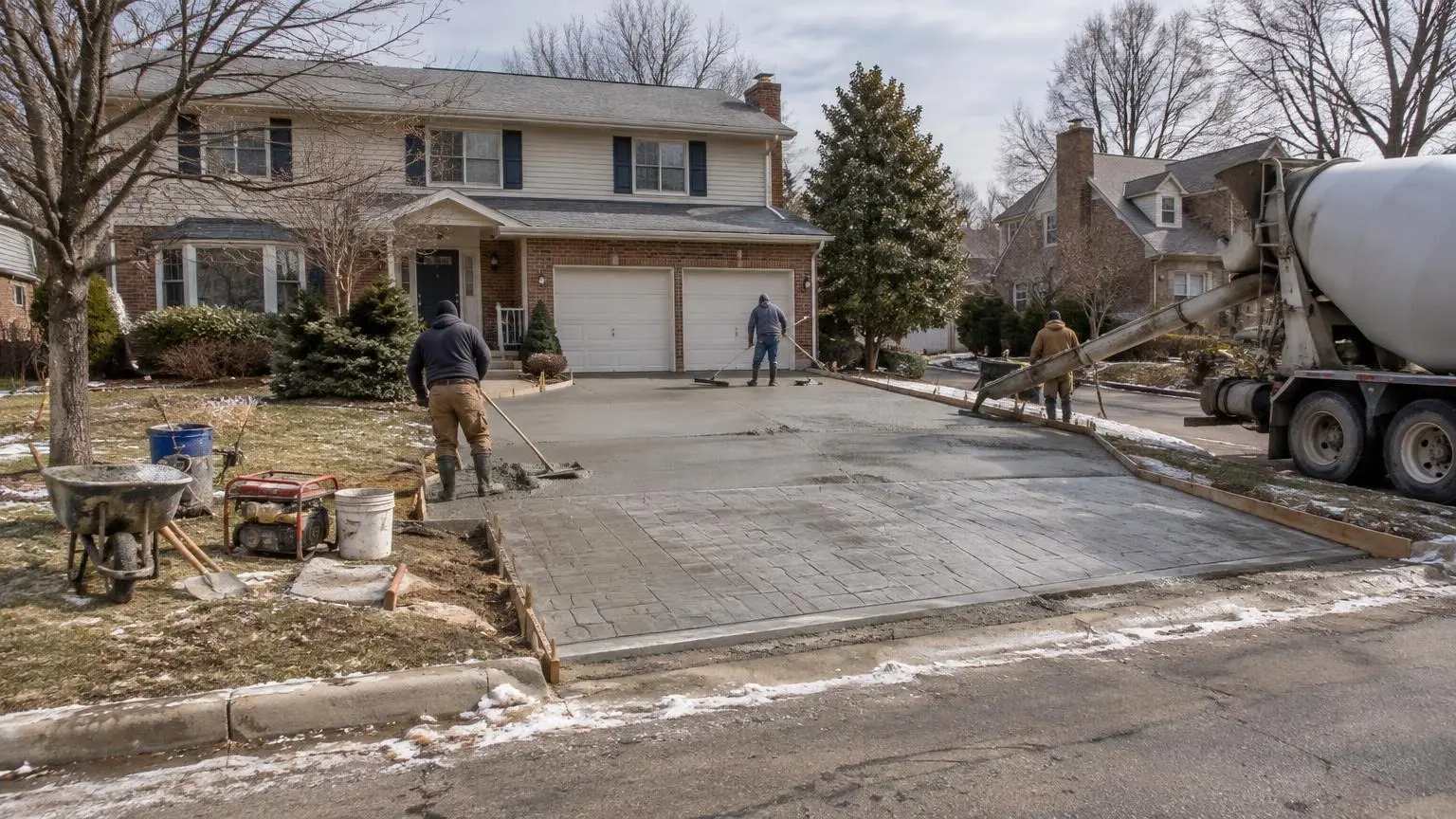
Concrete driveways in Wilmington take more abuse than most people realize. Through the winter they freeze and thaw over and over, get shoveled and plowed, and soak up salt that cars track in from the street. Many of the driveways we look at in the Brandywine valley suburbs were poured decades ago, and in the city a lot of off-street parking is a small pad behind a rowhome, reached from the alley. Whether it is a two-car drive in Brandywine Hundred or a single pad off an alley in the Highlands, the way it is built decides how long it lasts.
Signs it is time to replace your driveway
- Cracks wider than about a quarter inch, or cracks that keep growing and shifting
- Slabs that have sunk or tipped, especially near the garage or the street
- Large areas of scaling, where the surface has flaked off and the stone shows
- Water that pools on the driveway or runs toward the house
- A section heaved up by tree roots
- Crumbling edges where the slab was poured too thin
HomeGuide's leveling guide notes that cracks over a quarter inch, significant spalling and severe deterioration usually mean replacement is the better long-term choice. If only one or two slabs are bad, we may be able to replace just those sections.
How we build a driveway
We remove the old driveway and haul it away. Then we dig to the right depth, correct the grade so water runs away from the house and garage, and lay a compacted stone base. Forms go in, and so does reinforcement where it is needed. The concrete is an air-entrained mix, which holds tiny air bubbles that give freezing water room to expand. HomeGuide's driveway guide gives 4 inches as the minimum for passenger cars, 5 to 6 inches for heavier vehicles, and 6 to 8 inches at the edges. We thicken the edges and the apron, where tires roll on and off and where the slab is weakest.
After the pour, the surface gets a broom finish for traction on icy mornings. Control joints are cut or tooled in a planned pattern so the shrinkage cracks every slab develops form in straight lines inside the joints instead of wandering across the middle.
Aprons, curb cuts and alley pads
The apron is the part of the driveway between the street and the sidewalk, and it usually sits in the public right-of-way. Replacing it or adding a new curb cut is the kind of work that typically needs approval from the city or county. We check what is required for your address before we schedule. For rowhome parking pads off an alley, we pay close attention to how water drains toward the alley and away from the back wall of the house.
Options for the surface
- Broom finish: the standard, with good grip in winter.
- Exposed aggregate: the top layer is washed off to show the stone, which hides dirt and adds texture.
- Stamped or colored borders: a plain center with a patterned edge, or a full stamped driveway.
- Widening: an extra lane or a turnaround added to an existing driveway.
Caring for a new driveway
Keep cars off it until we tell you it is ready, usually about a week, and keep heavy trucks off longer. During the first winter, do not use rock salt. Shovel early and use sand for traction. Once the concrete has cured for about a month, a penetrating sealer helps keep water and salt out; plan to reseal every few years. Fill any cracks that open up before water can get in and freeze.
What This Covers
A concrete driveway job covers everything from the old slab coming out to the sealer going on.
Tear-out and hauling
Old concrete or asphalt broken up, loaded and removed from the site.
Grading and stone base
Subgrade shaped to drain and a compacted stone base placed under the slab.
Reinforcement
Rebar or wire mesh where the slab size, soil or vehicles call for it.
Air-entrained pour and broom finish
A freeze-thaw mix, finished with a broom texture for traction.
Control joints
Joints laid out to control cracking at the right spacing for the slab size.
Aprons and parking pads
Street aprons, alley pads and widenings matched to the existing drive.
Typical Concrete Driveway Costs
| Driveway | Published range |
|---|---|
| Plain concrete, per sq ft | $6 to $10 |
| One-car, 10 x 20 ft | $1,200 to $3,000 |
| One-car, 12 x 24 ft | $1,700 to $4,300 |
| Two-car, 20 x 20 ft | $2,400 to $6,000 |
| Two-car, 24 x 24 ft | $3,500 to $8,600 |
| Old driveway removal, per sq ft | $2 to $6 |
| Rebar reinforcement, per sq ft | $1 to $3 |
| Sealing, per sq ft | $1 to $3 |
National ranges from HomeGuide's concrete driveway cost guide. Wilmington-area prices can differ, and demolition, access, grading, thickness and finish all change the total. Your written estimate is the price.
How It Works
1. Measure and look
We measure, check drainage and grade, and note roots, the apron and how the old slab failed.
2. Tear out and prepare
Old concrete comes out, the subgrade is shaped and a stone base is compacted.
3. Form and pour
Forms and reinforcement go in, then the air-entrained concrete is placed, finished and jointed.
4. Cure and hand back
The slab cures before traffic. We tell you when to drive on it and when to seal it.
Concrete Driveways Questions
How much does a new concrete driveway cost in Wilmington?
HomeGuide's national range for a two-car, 20 by 20 foot driveway is about $2,400 to $6,000, and a larger 24 by 24 foot driveway runs about $3,500 to $8,600. Removing the old driveway adds about $2 to $6 per square foot. We give you a written number after measuring.
How thick should a driveway be?
HomeGuide lists 4 inches as the minimum for passenger cars and 5 to 6 inches for heavier vehicles, with thickened edges of 6 to 8 inches. We size the slab to what you park on it.
How long before I can drive on new concrete?
Usually about a week for cars, and longer for heavy vehicles. Cooler weather slows curing, so in spring and fall we may ask you to wait a few more days.
Can I salt my new driveway?
Avoid rock salt and other de-icers on new concrete for the whole first winter. Use sand for traction and shovel early. After that, sealing the driveway helps protect it from salt.
Can you replace just part of my driveway?
Often, yes. If one or two slabs are sunken or broken and the rest are sound, we can cut them out at the joints and replace them. The new concrete will be a slightly different shade at first.
Concrete Driveways Service Areas
- Concrete Contractors in Wilmington, DE
- Concrete Contractors in Newark, DE
- Concrete Contractors in New Castle, DE
- Concrete Contractors in Newport, DE
- Concrete Contractors in Elsmere, DE
- Concrete Contractors in Claymont, DE
- Concrete Contractors in Pike Creek, DE
- Concrete Contractors in Hockessin, DE
- Concrete Contractors in Greenville, DE
- Concrete Contractors in Bear, DE
- Concrete Contractors in Glasgow, DE
- Concrete Contractors in Middletown, DE
- Concrete Contractors in Delaware City, DE
- Concrete Contractors in Arden, DE
- Concrete Contractors in Bellefonte, DE
- Concrete Contractors in Brookside, DE
- Concrete Contractors in Edgemoor, DE
- Concrete Contractors in Pike Creek Valley, DE
- Concrete Contractors in Wilmington Manor, DE
- Concrete Contractors in Kennett Square, PA
- Concrete Contractors in Chadds Ford, PA
- Concrete Contractors in Pennsville, NJ
Get a Concrete Driveways Estimate
Free driveway estimates in Wilmington and across New Castle County.