
Population nearly doubled from 7,856 in 1970 to 15,255 in 1980
Concrete Contractors in Brookside, DE
Driveway replacement, patios, walkways and repair for neighborhoods that filled in during the 1970s.
- Free on-site estimates with measurements
- Itemized written quote before any work starts
- Air-entrained mixes and planned control joints for Delaware winters
Brookside's 1970s Concrete
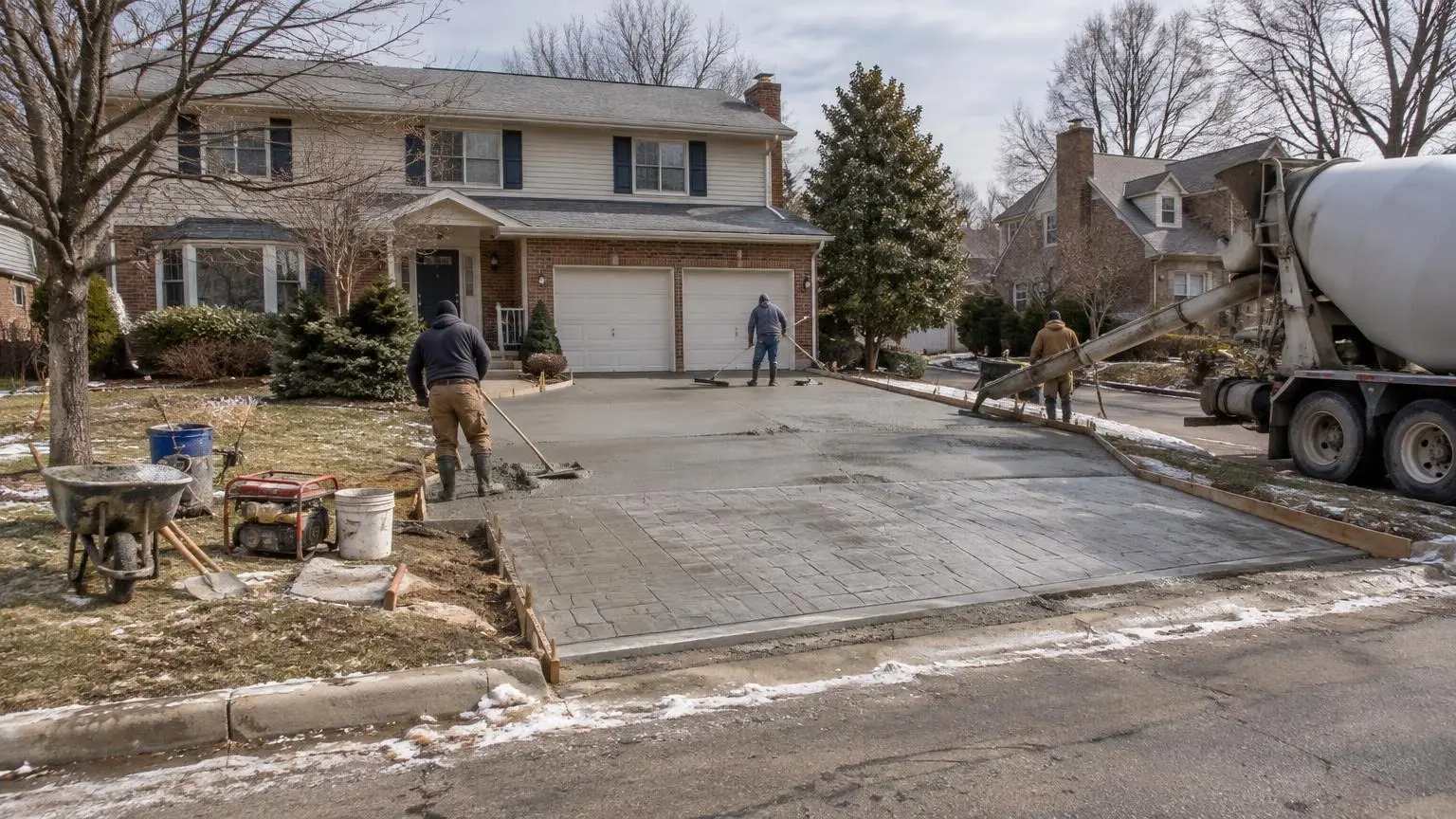
Brookside is a census-designated place of about 3.9 square miles in the Newark area, and concrete contractors here see a lot of homes from one decade. Census counts show 7,856 residents in 1970 and 15,255 in 1980, nearly double in ten years. Since then the population has stayed close to 15,000; the 2020 count was 14,974, with 5,838 housing units. When a community grows that fast and then levels off, most of its driveways, walks and patios were poured around the same time and are now about 45 to 55 years old.
Signs your concrete has reached the end
Concrete from the 1970s has been through roughly half a century of freezing, thawing, salting and parking. Some of it still has years left. Some does not. Here is how we tell:
Cracks that move. If one side of a crack is higher than the other, the base underneath has shifted.
Flaking surface. Scaling and pop-outs mean water and salt have broken down the top layer.
Sinking near the house. Driveways, walks and stoops that dip toward the foundation have lost support where backfill settled.
Pieces that rock. When you can feel a section move underfoot or under a tire, it is time for replacement.
Replacement, step by step
When a driveway or walk needs to go, we remove the old concrete and haul it away. We dig out soft soil and place a compacted stone base. We set forms for the correct pitch, pour air-entrained concrete, finish the surface and cut control joints at the right spacing. Then we cure it and tell you when to walk and drive on it. Replacing a 1970s driveway also gives you a chance to widen it, since many were sized for one car.
Tree roots from mature yards
Trees planted when these neighborhoods were new have had half a century to grow, and their roots are now big enough to lift walks and crack driveway edges. When we replace concrete near a large tree, we discuss options with you: moving the walk a little farther away, adding reinforcement, or asking an arborist about roots before we cut. Ignoring the roots just sets up the same damage again.
Flat ground, careful pitch
Brookside sits at about 75 feet, low enough that drainage is subtle: a slab needs a deliberate fall, or water lingers. We set every slab to drain away from the house and check where downspouts empty. Fixing the water problem is part of making new concrete last.
Patios and stamped work
A 1970s house often has a small slab out back, or none. Many Brookside owners now want a patio sized for outdoor dining. Stamped concrete is a common pick because it adds texture and color without the shifting and weeds that come with pavers. We show sample patterns, place joints to follow the design and seal the finished surface.
Slabs and small structures
We also pour shed slabs, pads for HVAC equipment and garage floor replacements. Each slab gets a base and thickness matched to its load. A shed slab needs a level surface and, where walls sit, a thicker edge.
Steps and stoops on split-levels and ranches
Homes from this era often have a short run of steps or a single stoop at the front door. Over decades, those stoops settle, crack at the corners or pull away from the house. Rebuilding a stoop at the right height to meet the threshold keeps water out of the door frame and makes the entry safer. We form a slight pitch away from the door and finish it with a texture that grips.
Keeping new concrete healthy
After the pour, simple habits matter. Keep heavy vehicles off a new driveway until we say it is ready. Skip deicing salt during the first winter. Reseal every few years. Fill small cracks before winter so water cannot get in and freeze. With a good base and good care, a new slab can serve another generation.
Brookside by the Numbers
- A 1970s growth spurt. Brookside grew from 7,856 residents in 1970 to 15,255 in 1980 and has stayed near 15,000 since.
- Housing today. The 2020 census counted 14,974 residents and 5,838 housing units across about 3.9 square miles.
- Elevation. The community sits at about 75 feet and is split between the Christiana and Newark high school zones.
Our Services in Brookside, DE
Brookside Questions
My 1970s driveway only fits one car. Can you widen it when you replace it?
Yes. Replacement is the right time to widen. We plan the new width, grade and drainage together and pour it as one driveway.
Can old Brookside concrete be resurfaced instead of replaced?
If the slab is level and only the surface is worn, a resurface may work. If it is cracked through, sunken or rocking, replacement is the lasting fix.
Can you pour a pad for a new HVAC unit?
Yes. We pour a level pad on a compacted base, sized for the equipment.
Free Estimates in Brookside, DE
Free on-site estimates throughout Brookside.
Concrete Contractors Near Brookside
- Concrete Contractors in Wilmington, DE
- Concrete Contractors in Newark, DE
- Concrete Contractors in New Castle, DE
- Concrete Contractors in Newport, DE
- Concrete Contractors in Elsmere, DE
- Concrete Contractors in Claymont, DE
- Concrete Contractors in Pike Creek, DE
- Concrete Contractors in Hockessin, DE
- Concrete Contractors in Greenville, DE
- Concrete Contractors in Bear, DE
- Concrete Contractors in Glasgow, DE
- Concrete Contractors in Middletown, DE
- Concrete Contractors in Delaware City, DE
- Concrete Contractors in Arden, DE
- Concrete Contractors in Bellefonte, DE
- Concrete Contractors in Edgemoor, DE
- Concrete Contractors in Pike Creek Valley, DE
- Concrete Contractors in Wilmington Manor, DE
- Concrete Contractors in Kennett Square, PA
- Concrete Contractors in Chadds Ford, PA
- Concrete Contractors in Pennsville, NJ